 Cardiovascular Physiology Concepts, 3rd edition textbook, Published by Wolters Kluwer (2021)
 Normal and Abnormal Blood Pressure, published by Richard E. Klabunde (2013)
Mechanisms of Capillary Exchange
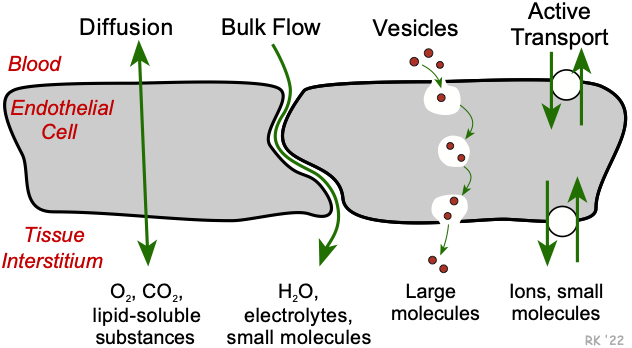
Fluid, electrolytes, gases, small and large molecular weight substances can transverse the capillary endothelium by several mechanisms: diffusion, bulk flow, vesicular transport, and active transport. These mechanisms are depicted in the following figure and discussed in the subsequent text:
Diffusion
- Particularly important for gases (O2 and CO2) and lipid-soluble substances (e.g., anesthetics); fluid and electrolytes are also exchanged, in part, by diffusion forces.
- Fick's First Law of diffusion:
 Where dn/dt is flux in moles/sec, D is the diffusion constant, A is surface area, ΔC is concentration difference, and ΔX is the thickness of the barrier to diffusion
- The movement (or flux) of a molecule is directly related to its diffusion constant across the barrier, the surface area available for diffusion, and the concentration gradient across the barrier. For O2 diffusing from the exchange vessels into the tissue, increasing the partial pressure of oxygen (PO2) in the plasma, or increasing the surface area for exchange (i.e., increasing the number of open capillaries), increases the total amount of O2 per unit time moving out of the blood and into the tissue.
Bulk Flow (Convection)
- Bulk flow of fluid and electrolytes occurs through "pores" and intercellular clefts.
- This mechanism of exchange is indispensable in renal glomerular capillaries, which have a high filtration rate; however, it occurs to a variable extent in nearly all tissues.
- Bulk flow follows Poiseuille’s equation for hydrodynamic flow. Therefore, changes in pressure driving forces (either hydrostatic or osmotic) and in the size of "pores" or intercellular clefts will alter exchange. Contraction of capillary endothelial cells by substances such as histamine and bradykinin increases intercellular pore size and augments fluid and electrolyte movement by increasing the capillary filtration constant.
- There is some evidence that vesicles can fuse, creating pores across endothelial cells (not shown in figure).
Vesicular Transport
- Vesicular transport is involved in the translocation of macromolecules across capillary endothelium. Water and solutes enter vesicles that are fused with the plasma side of the cell membrane, then are translocated through the endothelial cell to the interstitial side, where they are released into the interstitium.
Active Transport
- Some molecules (e.g., ions, glucose, amino acids) can move across the endothelial cell by active transport mechanisms.
Revised 11/05/2023
 Twitter
 Telegram
 LinkedIn
 WhatsApp
 Facebook
 Reddit