 Cardiovascular Physiology Concepts, 3rd edition textbook, Published by Wolters Kluwer (2021)
 Normal and Abnormal Blood Pressure, published by Richard E. Klabunde (2013)
Laminar Flow
Laminar flow is the normal condition for blood flow throughout most of the circulatory system. It is characterized by concentric layers of blood moving in parallel down the length of a blood vessel. The highest velocity (Vmax) is found in the center of the vessel. The lowest velocity (V=0) is found along the vessel wall. The flow profile is parabolic once laminar flow is fully developed. This occurs in long, straight blood vessels, under steady flow conditions.
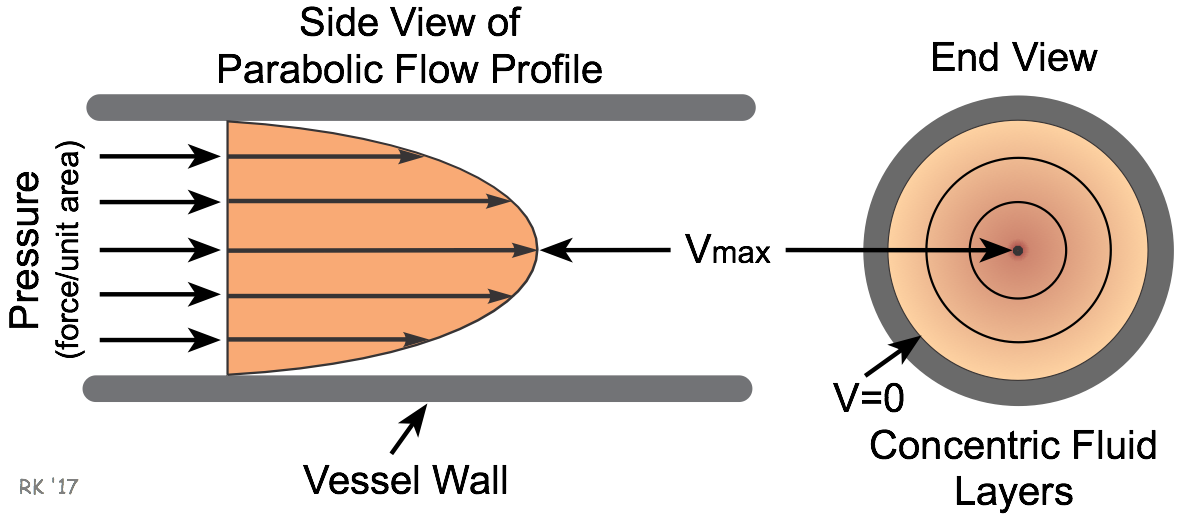
It is important to note that the conditions for laminar, parabolic flow are not fully met in the aorta, particularly within the aortic arch. This is because of the pulsatile nature of ventricular ejection and high velocities, both of which contribute to disruption of laminar flow. As flow becomes less pulsatile in distal arterial branches, laminar flow conditions are achieved.
One practical implication of parabolic laminar flow is that when flow velocity is measured using a Doppler flowmeter, the velocity value represents the average velocity of a cross-section of the vessel, not the maximal velocity found in the center of the flow stream.
The orderly movement of adjacent layers of blood flow through a vessel helps to reduce energy losses in the flowing blood by minimizing viscous interactions between the adjacent layers of blood and the wall of the blood vessel. Disruption of laminar flow leads to turbulence and increased energy losses.
Revised 11/05/2023
 Twitter
 Telegram
 LinkedIn
 WhatsApp
 Facebook
 Reddit