 Cardiovascular Physiology Concepts, 3rd edition textbook, Published by Wolters Kluwer (2021)
 Normal and Abnormal Blood Pressure, published by Richard E. Klabunde (2013)
Aortic Regurgitation
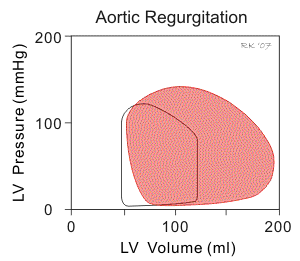 The following describes changes that occur in the left ventricular pressure-volume loop when there is aortic regurgitation. In aortic valve regurgitation (red loop in figure), the aortic valve does not close completely at the end of systolic ejection. As the ventricle relaxes during diastole, blood flows from the aorta back into the ventricle, so the ventricle immediately begins to fill from the aorta (before filling from the left atrium). Therefore, there is no true phase of isovolumetric relaxation (no vertical line between aortic valve closure and mitral valve opening) because as the ventricle relaxes, even before the mitral valve opens, blood is entering the ventricle from the aorta, thereby increasing ventricular volume. Once the mitral valve opens, filling occurs from the left atrium; however, blood continues to flow from the aorta into the ventricle throughout diastole because aortic pressure is higher than ventricular pressure during diastole. This augments ventricular filling so that end-diastolic volume is increased as shown in the pressure-volume loop. Ventricular end-diastolic volume is also increased because in chronic aortic regurgitation the ventricle anatomically dilates (remodels), which increases ventricular compliance.
When the ventricle begins to contract and develop pressure, blood is still entering the ventricle from the aorta because aortic pressure is higher than ventricular pressure; therefore, there is no true isovolumetric contraction because volume continues to increase. Once the ventricular pressure exceeds the aortic diastolic pressure, the ventricle ejects blood into the aorta. The increased end-diastolic volume (increased preload) activates the Frank-Starling mechanism to increase the force of contraction, ventricular peak (systolic) pressure, and stroke volume (as shown by the increased width of the pressure-volume loop). If the ventricle is not in failure, end-systolic volume may only be increased a small amount (as shown in figure) due to the increased afterload (ventricular wall stress). If the ventricle goes into systolic failure, then end-systolic volume will increase by a large amount and the peak systolic pressure and stroke volume and net forward flow into the aorta will fall.
The changes just described do not include cardiac and systemic compensatory mechanisms (e.g., systemic vasoconstriction, increased blood volume, and increased heart rate and inotropy) that attempt to maintain cardiac output and arterial pressure. Therefore, the red loop depicted in the figure only represents what may occur under a given set of conditions.
Revised 01/27/2023
 Twitter
 Telegram
 LinkedIn
 WhatsApp
 Facebook
 Reddit