
 Cardiovascular Physiology Concepts, 3rd edition textbook, Published by Wolters Kluwer (2021)
 Normal and Abnormal Blood Pressure, published by Richard E. Klabunde (2013)
Mitral Stenosis
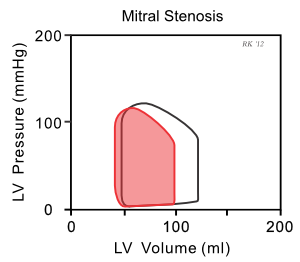 The following describes changes that occur in the left ventricular pressure-volume (PV) loop when there is mitral stenosis. Mitral stenosis (red PV loop in figure) impairs left ventricular filling, which reduces in end-diastolic volume (preload). This leads to a decrease in stroke volume (reduced width of PV loop) by the Frank-Starling mechanism and a fall in cardiac output. Reduced ventricular filling and reduced aortic pressure decrease ventricular wall stress (afterload), which may cause a small decrease in ventricular end-systolic volume. However, this does not offset the reduction in end-diastolic volume. Therefore, because end-diastolic volume decreases more than end-systolic volume decreases, the stroke volume (shown as the width of the loop) decreases.
The changes described above do not include cardiac and systemic compensatory mechanisms (e.g., systemic vasoconstriction, increased blood volume, and increased heart rate and inotropy) that attempt to maintain cardiac output and arterial pressure. Therefore, the red loop depicted in the figure only represents what occurs in the absence of these compensatory responses.
Revised 01/27/2023
 Twitter
 Telegram
 LinkedIn
 WhatsApp
 Facebook
 Reddit