
 Cardiovascular Physiology Concepts, 3rd edition textbook, Published by Wolters Kluwer (2021)
 Normal and Abnormal Blood Pressure, published by Richard E. Klabunde (2013)
Compliance
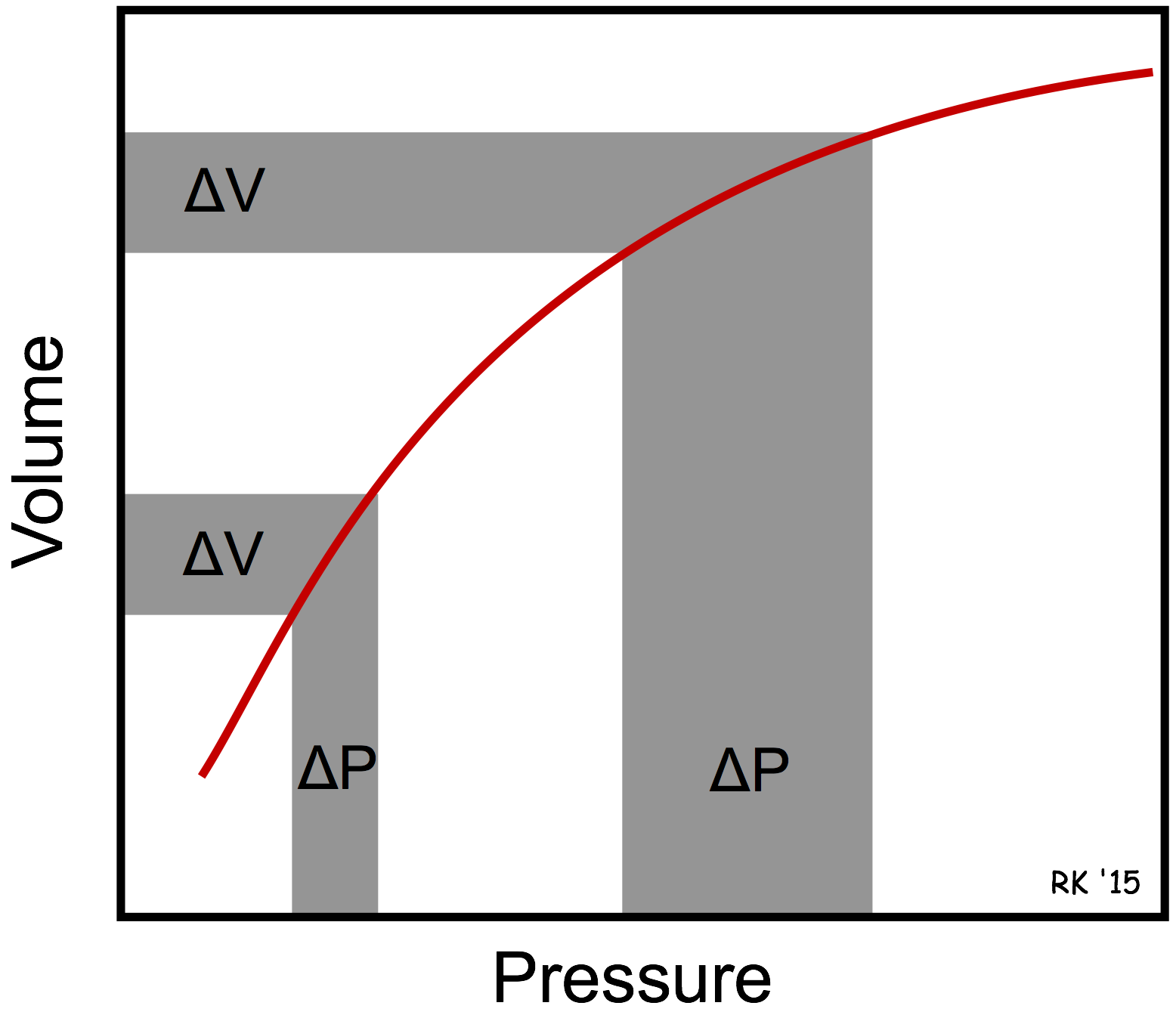 The term compliance is used to describe how easily a chamber of the heart or the lumen of a blood vessel expands when it is filled with a volume of blood. Physically, compliance (C) is defined as the change in volume (ΔV) divided by the change in pressure (ΔP).
C = ΔV / ΔP
For example, if an isolated segment of an artery is cannulated and the volume of fluid within the segment is slowly increased while measuring pressure, a plot of volume versus pressure can be generated (see figure). The slope (or tangent) of the curve at any pressure and volume (dV/dP) represents the compliance of the vessel at that pressure and volume. This figure indicates that the compliance of the artery is not constant and decreases as the vessel expands. At higher volumes and pressures, there is a greater change in pressure for a change in volume. Another way to think of this is that the "stiffness" of the vessel wall (reciprocal of compliance) increases at higher volumes and pressures. This non-linearity in the relationship between volume and pressure is common in biological tissues.
Compliance is a fundamental property of a tissue; however, the compliance can be modified by histological changes in the tissue. This occurs, for example, when a heart structurally remodels in response to chronic volume or pressure overload conditions. In a blood vessel, compliance can also be altered by contraction of smooth muscle in the vessel wall, which decreases the compliance of the vessel.
A short (3.5 minute) YouTube lecture on this topic can be viewed by clicking on Compliance: illustrated definition.
Click below to learn more about the importance of compliance in
Revised 01/24/2023
 Twitter
 Telegram
 LinkedIn
 WhatsApp
 Facebook
 Reddit