
 Cardiovascular Physiology Concepts, 3rd edition textbook, Published by Wolters Kluwer (2021)
 Normal and Abnormal Blood Pressure, published by Richard E. Klabunde (2013)
Effects of Preload on Cardiac Fiber Shortening
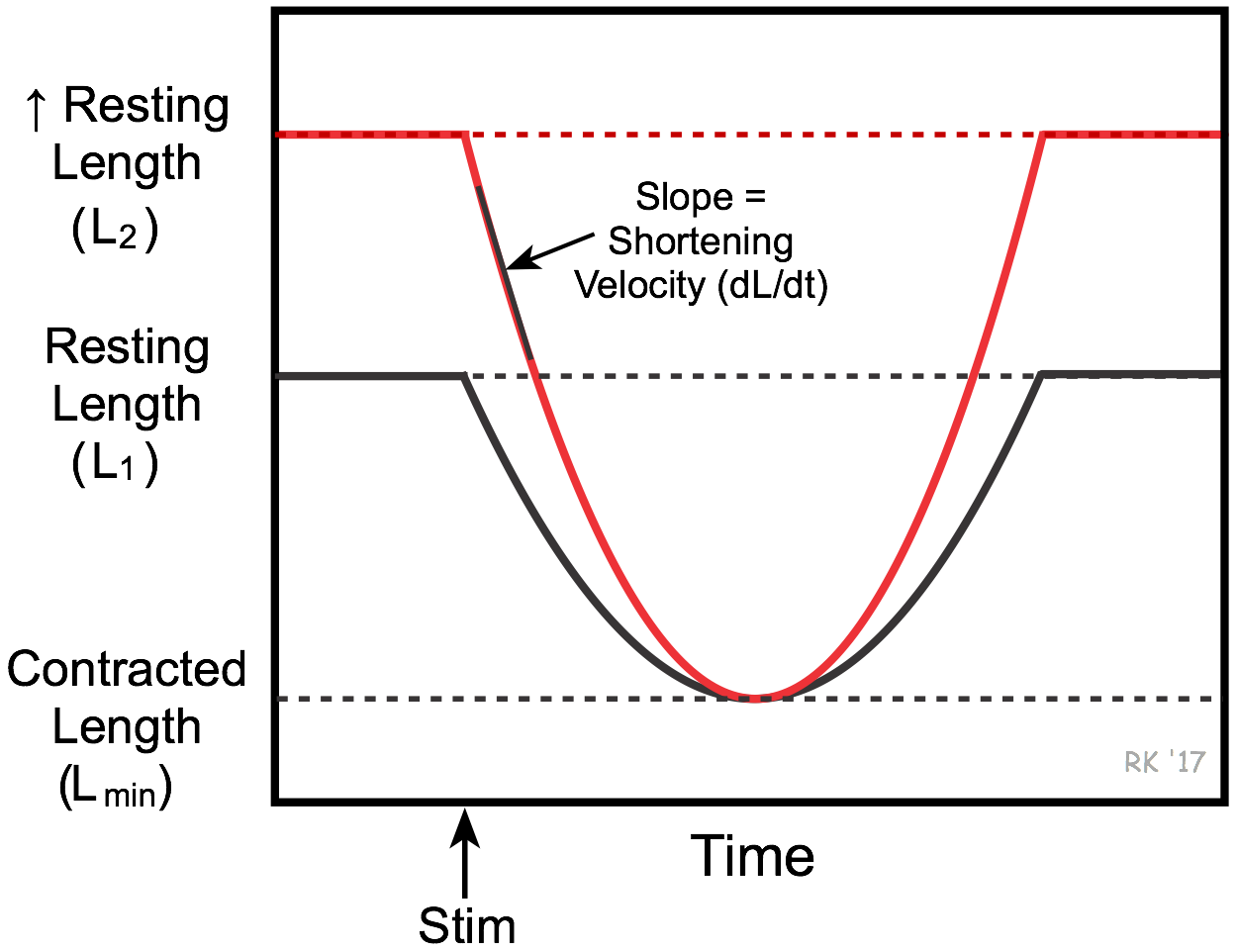
The mechanical properties of cardiac muscle contraction and relaxation can be studied using isolated muscle fibers in vitro. When electrically stimulated to contract and shorten against a fixed afterload (isotonic contraction), the muscle length will decrease from its resting length (L1; preload) to a minimal contracted length (Lmin), and then relax to its previous resting length (black tracing). If the resting length before contraction is increased from L1 to L2 (increased preload) and the muscle stimulated to contract, it will shorten to the same Lmin (red tracing). Therefore, increasing the preload increases the magnitude of shortening, and the muscle shortens more rapidly (increased shortening velocity; increased dL/dt). The effects of preload on the velocity of shortening can also be illustrated using the force-velocity relationship.
In summary, at a fixed afterload on the muscle, increasing preload:
- Increases the magnitude of shortening (to same minimal contracted length)
- Increases the velocity of shortening.
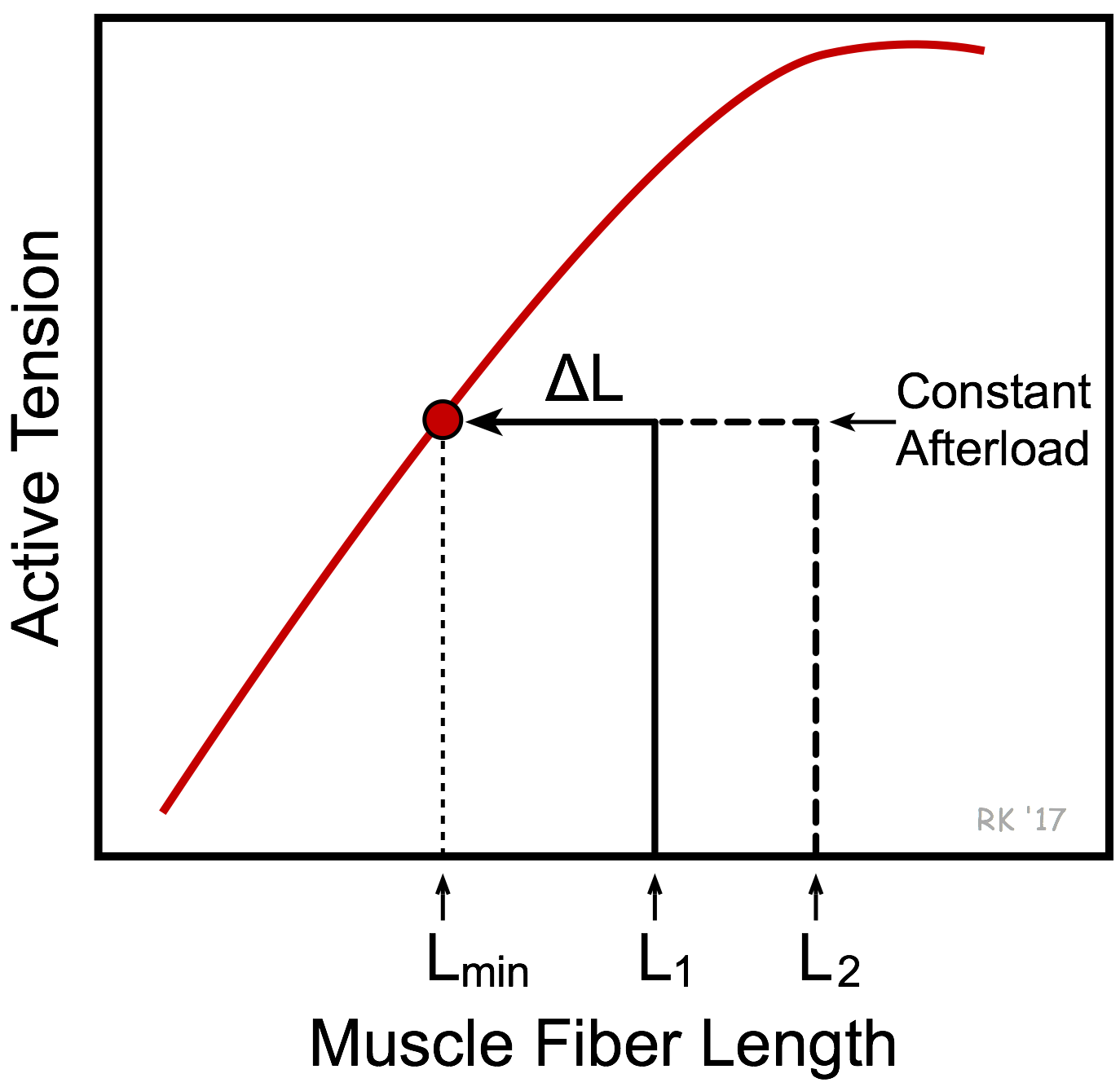 The effects of increasing preload on muscle fiber shortening can also be depicted using a length-tension diagram. With the muscle preload length at L1, stimulating a muscle to contract will cause it to increase tension development until a fixed afterload tension is reached, then the muscle will shorten (black, solid horizontal arrow) with no further increase in tension to a minimal contracted length (Lmin). If the preload before contraction is increased from L1 to L2 and the muscle contracted with the same constant afterload, the muscle will shorten (black, dashed line and solid arrow) to the same Lmin. Therefore, a normal cardiac muscle fiber will contract to the same minimal length regardless of the preload, as long as the preload is within a normal physiologic range.
Revised 11/04/2023
 Twitter
 Telegram
 LinkedIn
 WhatsApp
 Facebook
 Reddit