 Cardiovascular Physiology Concepts, 3rd edition textbook, Published by Wolters Kluwer (2021)
 Normal and Abnormal Blood Pressure, published by Richard E. Klabunde (2013)
Endothelial Mechanisms Regulating Blood Flow
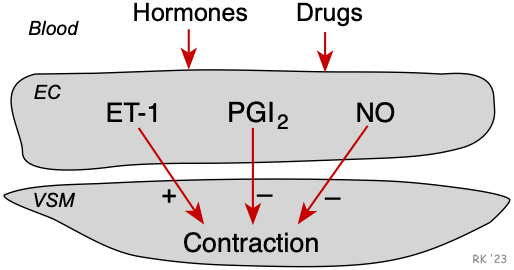 Vascular endothelium has an important role in regulating smooth muscle function and in modulating leukocyte and platelet adhesion to the endothelium. As shown in the figure, various blood-borne substances such as hormones and drugs that come in contact with vascular endothelial cells (EC) cause the production and release of endothelial factors that promote contraction (+) or relaxation (-) of vascular smooth muscle (VSM). These endothelial factors, therefore, modulate the effects of norepinephrine (NE) released by sympathetic nerves (SN), and the effects of tissue metabolites and humoral factors on the vascular smooth muscle.
The three most influential endothelial-derived substances are nitric oxide (NO), endothelin (ET-1), and prostacyclin (PGI2). Nitric oxide and PGI2 act as vasodilators, whereas ET-1 serves as a vasoconstrictor.
Damage to the vascular endothelium because of atherosclerotic processes or following ischemia and reperfusion alters the formation and release of endothelial factors. When endothelial damage occurs, the endothelium produces less nitric oxide and prostacyclin, which causes the sympathetic vasoconstrictor tone to be unopposed. This can lead to increased vascular tone and vasospasm. Excessive production of ET-1, especially if NO produced is reduced, leads to enhanced vasoconstriction. Endothelin receptor blockers are used in treating pulmonary hypertension, for example. Decreased production of both NO and PGI2 can lead to increased platelet adhesion and aggregation, and therefore enhanced thrombogenesis.
Revised 11/03/2023
 Twitter
 Telegram
 LinkedIn
 WhatsApp
 Facebook
 Reddit