 Cardiovascular Physiology Concepts, 3rd edition textbook, Published by Wolters Kluwer (2021)
 Normal and Abnormal Blood Pressure, published by Richard E. Klabunde (2013)
Control of Heart Rate
Heart rate is normally determined by the pacemaker activity of the sinoatrial node (SA node) in the posterior wall of the right atrium. The SA node exhibits automaticity that is determined by spontaneous changes in Ca++, Na+, and K+ conductances. This intrinsic automaticity, if left unmodified by neurohumoral factors, exhibits a spontaneous firing rate of 100-110 beats/min. This intrinsic firing rate decreases with age.
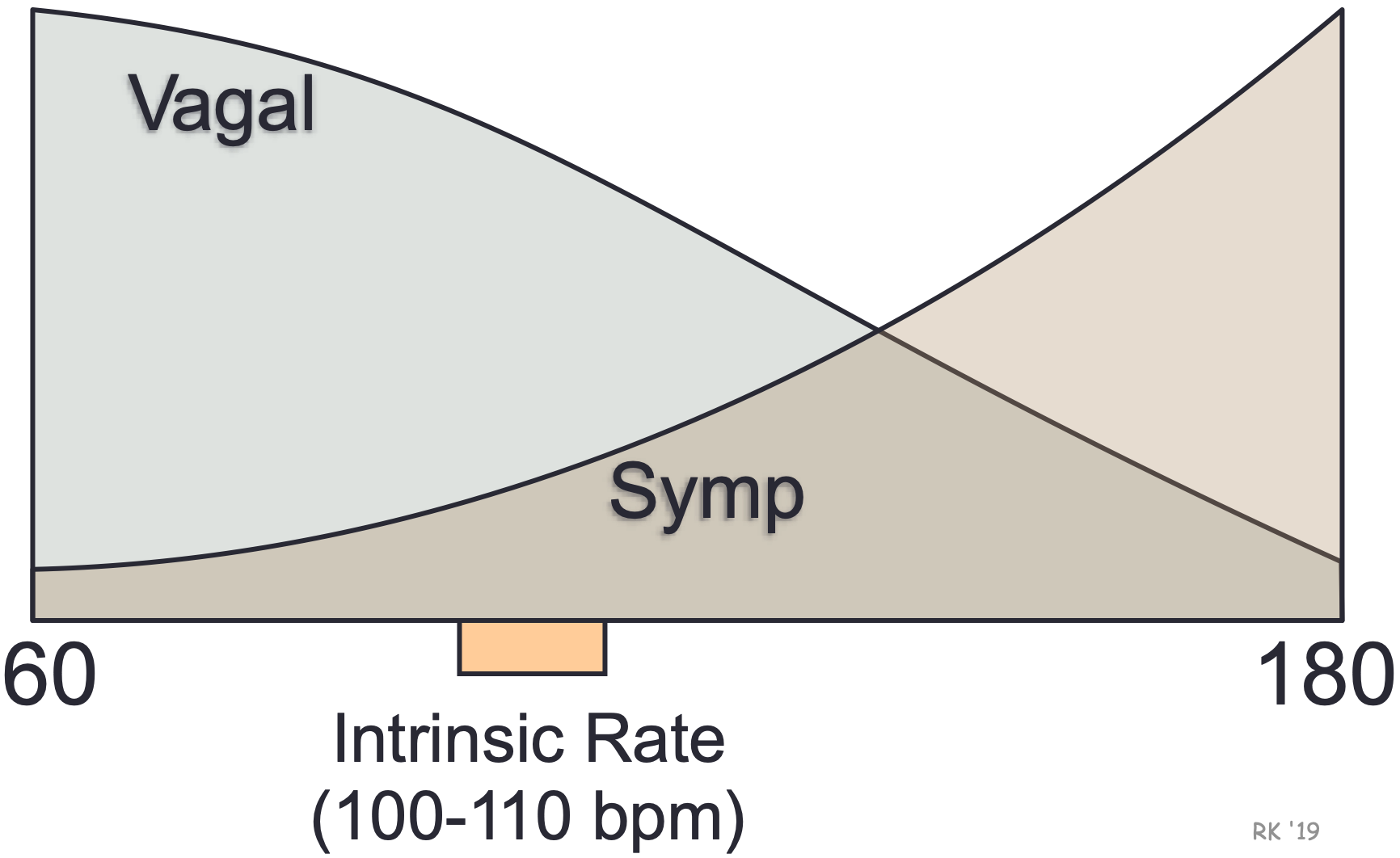 Heart rate is decreased below the intrinsic rate, primarily by activation of the vagus nerve innervating the SA node. Normally, at rest, there is significant vagal tone on the SA node so that the resting heart rate is between 60 and 80 beats/min. This vagal influence can be demonstrated by administration of atropine, a muscarinic receptor antagonist, which leads to a 20-40 beats/min increase in heart rate depending upon the initial level of vagal tone.
For the heart rate to increase above the intrinsic rate, there is both a withdrawal of vagal tone and an activation of sympathetic nerves innervating the SA node. This reciprocal change in sympathetic and parasympathetic activity permits the heart rate to increase during exercise, for example.
Heart rate is changed by circulating catecholamines acting via β1-adrenoceptors on SA nodal cells. Heart rate is also changed by changes in circulating thyroxin (thyrotoxicosis causes tachycardia) and by changes in body core temperature (hyperthermia increases heart rate).
SA nodal dysfunction can lead to sinus bradycardia, sinus tachycardia, or sick-sinus syndrome.
The maximal heart rate (max HR) that can be achieved in an individual is often estimated by:
Max HR = 220 beats/min − age in years
Although this formula is commonly used in the US fitness health industry, many studies have shown that this simple formula underestimates max HR by 10 or more beats/min in older individuals. A study done on more than 3000 healthy men and women of a wide age range (Scand J Med Sci Sports 23:697-704, 2013), showed that max HR is better estimated by 211 – (0.64 x age). The following comparison indicates the differences in estimated max HR for 30- and 70-year-old individuals based on these two calculations:
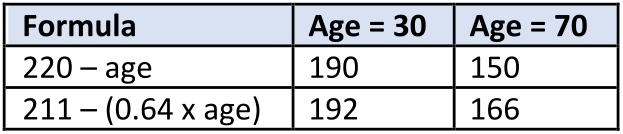
Therefore, max HR is reduced with increasing age, which also reduces maximal cardiac output during exertion. This effect is independent of gender, type of physical activity, maximal oxygen consumption, or body mass index. It is genetically determined and cannot be significantly modified by exercise training or by external factors.
Additional and more detailed information on the factors controlling heart rate can be found by clicking here.
Revised 11/03/2023
 Twitter
 Telegram
 LinkedIn
 WhatsApp
 Facebook
 Reddit